The Tech Stock Shake-Up: What's Really Happening and Where the Next Big Opportunity Lies
It’s a Monday morning, early October. Two analysts are about to go live on a podcast, and one of them, Dave Sekera from Morningstar, is holding a Halloween mug. "I don't know why," he says, "but for some reason I'm feeling it today." It’s a tiny, human detail in a conversation about monumental forces—government shutdowns, inflation, and the dizzying trajectory of the global economy. And it’s the perfect place to start, because it reminds us that behind the tickers and the terrifyingly abstract graphs of the stock market today, there are just people, trying to make sense of it all with the tools—and the coffee mugs—they have on hand.
For weeks, I've been watching the same data they are. I’ve seen the S&P 500 walk what they call a "tightrope," balanced precariously between an AI-fueled rocket launch and the gravitational pull of a weakening "real" economy. Most analysts see this as a risk, a sign of dangerous overvaluation. They see a bubble. But I see something else entirely. When I look at the stock market today, I don't just see a financial ledger. I see a story. I see the world's largest, most chaotic, and most honest crowdfunding campaign for the future. And right now, we are funding one specific future with an almost religious fervor.
The AI Singularity in Our Wallets
Let’s get the raw numbers out of the way, because they’re staggering. At the start of this year's second half, the top 10 stocks in the market accounted for a mind-bending 74% of its total return. By the end of the third quarter, that number had "broadened out" to a mere 53%. Think about that. More than half the entire market's momentum is being driven by just ten companies. And who are they? They are the architects of our coming age: the chip makers, the cloud giants, the AI pioneers. The market isn't just favoring tech; it’s singularly obsessed with the promise of artificial intelligence.
This is where most financial commentary stops. But that's not the real story, is it? We're witnessing a fundamental shift in what the market is. It’s no longer just a reflection of present-day corporate earnings. It’s become a predictive engine, a collective bet on a paradigm shift so massive we can’t even fully comprehend it. The insane premiums on growth stocks, especially those tied to AI, aren't just about discounted cash flows—in simpler terms, that’s just a way of calculating a company’s future profits in today’s dollars—it's about a belief that the future will be so radically different that traditional valuation metrics are becoming obsolete.
This is the kind of breakthrough that reminds me why I got into this field in the first place. The speed of this financial concentration is just staggering—it means the gap between the world we have and the one we're building is closing faster than we can even process, and our collective capital is the fuel. Are we just investing in companies anymore, or are we actively funding a transition, trying to pull a 2040 reality into the 2020s? What does it say about us that we're willing to pay an enormous premium not for what a company is, but for what it might one day make possible?
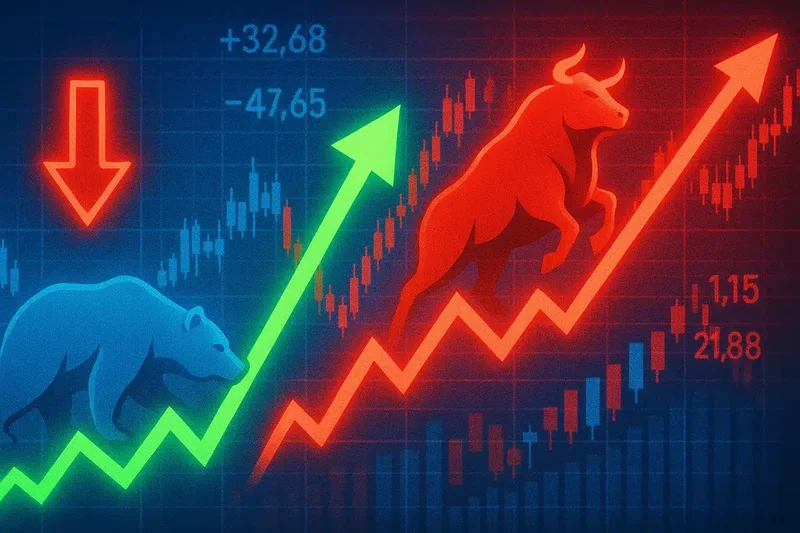
This is more than just stock market news; it's a referendum on human progress. Every time the Nasdaq ticks up, driven by another AI breakthrough, it’s a vote of confidence. It’s millions of people, from institutional investors to kids with a trading app, all saying in unison: "Yes. That one. That's the future we choose."
The Ghost in the Machine Economy
Of course, every grand vision has its shadow. The analysts on that podcast called it a "tightrope," and it’s a perfect metaphor. While the AI-centric stocks are soaring into the stratosphere, there’s a whole other economy back on Earth that’s showing signs of strain. S&P 500 heads for first decline in 8 days on Oracle slide, shutdown angst: Live updates. Sectors like real estate, healthcare, and basic materials are trading at a discount. Consumer spending is slowing. The old world of physical goods and essential human services—the things that keep society running day-to-day—is being undervalued, almost forgotten, in the gold rush for intelligence.
This is the tension at the heart of our modern moment. We're building a brilliant, automated, intelligent future, but we still have to live in the present. This reminds me of the early days of the internet. During the dot-com boom, companies with no profits and barely a business plan were valued in the billions, while stable, profitable "brick-and-mortar" businesses were dismissed as dinosaurs. We all know how that ended. The bubble burst.
But here’s the crucial part everyone forgets: the bubble wasn't a total failure. It was a messy, painful, but necessary process. All that "wasted" capital laid the fiber optic cables, built the server farms, and funded the foundational protocols that gave us the incredible connected world we have today. The dream was right, even if the timing and the valuations were wrong.
So when I see the market today, I have to ask: Is this time different? We have a responsibility to ensure that as we pour trillions into building the digital brain of the world, we don't neglect its body and soul. The undervalued healthcare sector, filled with medtech and device makers, represents the very real, physical needs of human beings. The discounted real estate sector represents the communities we live in. We can't let them become ghosts in the machine economy. The greatest challenge for us—for engineers, investors, and policymakers—is to bridge this gap. How do we ensure that the incredible wealth and productivity generated by AI doesn't just stay concentrated in a few digital giants, but flows back to strengthen the foundations of our society?
The Future Is Trading at a Premium
Let’s be clear. The market is not irrational. It is, however, emotional. It's a reflection of our collective hopes, and right now, our hope is overwhelmingly placed in the power of technology to solve our biggest problems. That 12% premium on growth stocks isn't a spreadsheet error; it's the price of admission for a shot at a radically better world. It’s the cost of optimism. And frankly, in a world facing the challenges we do, it might be the most valuable asset we have. The tightrope is real, and the risks are immense, but I wouldn't want to be standing anywhere else. We are betting on ourselves, and that’s a trade I’m willing to make every single day.