Zcash's Historic Surge: Market Recovery Signals and What It Means for Privacy
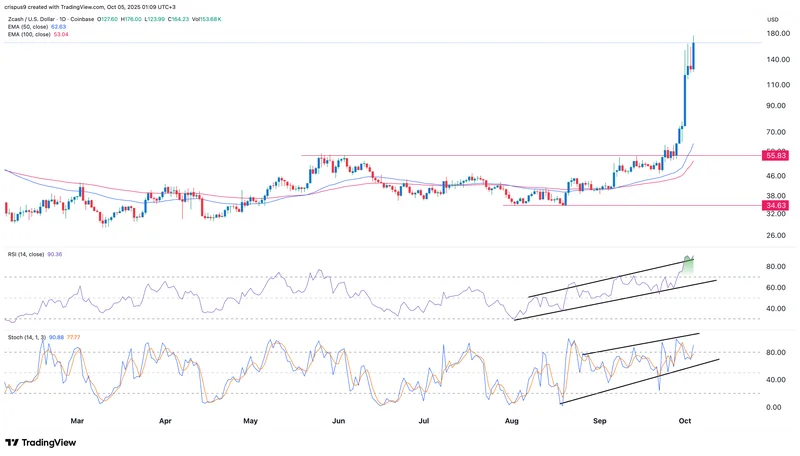
Alright, buckle up, folks, because something fascinating is happening in the crypto world, something that really gets my circuits firing! Zcash, remember that privacy coin that’s been quietly humming along for years? Well, it just went absolutely ballistic, surging tenfold in five weeks. Five weeks! That's not just a blip; that’s a seismic shift, and it demands our attention.
The Privacy Pendulum Swings Back
For years, Bitcoin has been the king, the undisputed champion. But lately, there’s been a growing unease. Centralization, corporate influence… it’s all starting to feel a little… well, watched. And that’s where Zcash comes in, riding a wave of renewed interest in cypherpunk principles. Think of it like this: Bitcoin is the town square, where everyone can see your transactions. Zcash, on the other hand, is like having a private, shielded room in that town square, where you can conduct business without broadcasting it to the world.
This isn't just about hiding from the government, though I know that's the first thing that comes to mind, right? It's about control. It's about deciding who gets to see your financial activity. It’s about protecting yourself from prying eyes, from corporations mining your data, from… well, from anyone who doesn’t need to know.
And the timing couldn’t be more perfect. The harsh sentencing of Keonne Rodriguez, the Samourai Wallet developer, sent shockwaves through the crypto community. Five years! For writing privacy software? That's a wake-up call, a stark reminder that the fight for digital freedom is far from over. It's a chilling effect, honestly. I mean, are we going to start punishing developers for writing code that protects our privacy? It’s absurd!
Zcash offers a solution, a way to transact anonymously using zero-knowledge proofs—in simpler terms, a way to prove you have the right to make a transaction without revealing any details about the transaction itself. It's like showing your ID to get into a bar; you prove you're old enough without revealing your address or your favorite drink.
Galaxy Digital analyst Will Owens calls Zcash a "spiritual successor" to Bitcoin, borrowing foundational elements but prioritizing privacy. And the numbers don't lie. Zcash briefly surpassed Hyperliquid in market capitalization. The price hit nearly $735, the highest since January 2018, triggering over $51 million in short liquidations. This isn’t just a flash in the pan; it's a clear signal that investors are taking privacy seriously. According to Crypto Briefing, Zcash surpasses Hyperliquid in market capitalization.
But is this sustainable? Is this a true paradigm shift, or just a temporary surge fueled by fear and uncertainty? That's the million-dollar question, isn’t it?
What happens when quantum computing breaks current encryption? What new privacy threats will emerge as technology advances?
The LivLive Connection: Privacy Beyond Finance
And here’s where it gets really interesting. Zcash isn’t the only project making waves. LivLive, an AR-powered social loyalty platform, is also seeing a surge in interest. Now, on the surface, these two projects couldn't be more different. Zcash is about financial privacy; LivLive is about rewarding real-world activity. But dig a little deeper, and you'll see a common thread: control over your data.
LivLive rewards users for walking, scanning locations, referring friends—turning everyday actions into tokenized income. It’s a "live-to-earn" economy, where your presence and participation are valued. It's about owning your data, profiting from your activity, and connecting with brands and businesses in a transparent, verifiable way.
When I first saw the LivLive demo, I honestly just sat back in my chair, speechless. Imagine a world where your daily walk earns you rewards, where your social interactions are valued, where you are in control of your digital footprint. It’s revolutionary!
It’s like the early days of the internet, when the possibilities seemed endless, when we believed that technology could truly empower individuals. And that’s what excites me most about Zcash and LivLive. They represent a return to those ideals, a reminder that technology can be used to protect our privacy, reward our participation, and create a more equitable future.
Of course, with great power comes great responsibility. We need to be mindful of the ethical implications of privacy-enhancing technologies. We need to ensure that they are not used for illicit purposes, that they are accessible to everyone, and that they are developed with the best interests of humanity in mind. But I believe that, with careful consideration and responsible development, these technologies can help us build a better, more private, and more equitable world for all.
Privacy is the New Black
So, what does this all mean? It means that the privacy pendulum is swinging back. It means that people are waking up to the importance of digital sovereignty. It means that the future of crypto is not just about finance; it's about freedom, control, and empowerment. The future is bright, my friends, and I, for one, am incredibly excited to see what comes next.