The Quiet Ascent of Larry Ellison: Why His Vision for the Future is Suddenly Everywhere
I keep seeing the same headlines, a drumbeat of suspicion and concern. "Trump Ally Larry Ellison Pushes to Control More Media." "Is Oracle's Larry Ellison a 'Shadow President'?" It’s a compelling narrative, I’ll grant you that. It paints a picture of a shadowy puppet master, one of the richest men in the world, pulling strings from his Hawaiian island of Lanai, weaving a web of influence through politics and media for his own inscrutable ends.
And I get it. When you see a single individual like the founder of Oracle funding the Tony Blair Institute, which then advocates for a national digital ID system that a company like Oracle is perfectly positioned to build… it’s easy to connect the dots in a straight, cynical line. But I think we’re missing the forest for the trees. We’re seeing a power play, when we should be seeing a systems architect at work on the grandest scale imaginable.
What if what we’re witnessing isn’t a conspiracy, but the messy, chaotic, and profoundly human attempt to build the world’s next operating system?
Think about your life right now. You have a driver's license for the state, a passport for the country, a dozen different logins for your bank, your healthcare provider, your tax agency. Each system is a silo, walled off and inefficient. They don’t talk to each other. Getting them to cooperate requires mountains of paperwork, endless phone calls, and a staggering amount of wasted human potential. It’s a broken, fragmented architecture.
Now, imagine a different world. A world with a single, secure, user-controlled digital identity. This isn’t just a "Britcard" or a national ID for right-to-work checks. This is a foundational key to a frictionless society. It’s the key that lets your new doctor instantly and securely access your medical history, with your permission. The key that allows government benefits to be deposited the moment you’re eligible, without you ever filling out a form. The key that proves your identity online, ending the scourge of bots and fake accounts.
This uses a concept called federated identity—in simpler terms, it means you have one secure, verifiable "you" online that you can use everywhere, without having to trust a hundred different companies with your personal data. That’s the vision being pushed by Blair’s institute, and yes, it’s a vision that Larry Ellison has been championing for decades, ever since he offered to help build a national ID system for the US after 9/11.
When I truly grasped the scale of this—the integration of governance, health, and media into a single, user-centric data layer—I honestly just had to sit back and process it. This is the kind of breakthrough that reminds me why I got into this field in the first place.
A Power Grab, or Society's Next Operating System?
The Architecture of a Coherent World
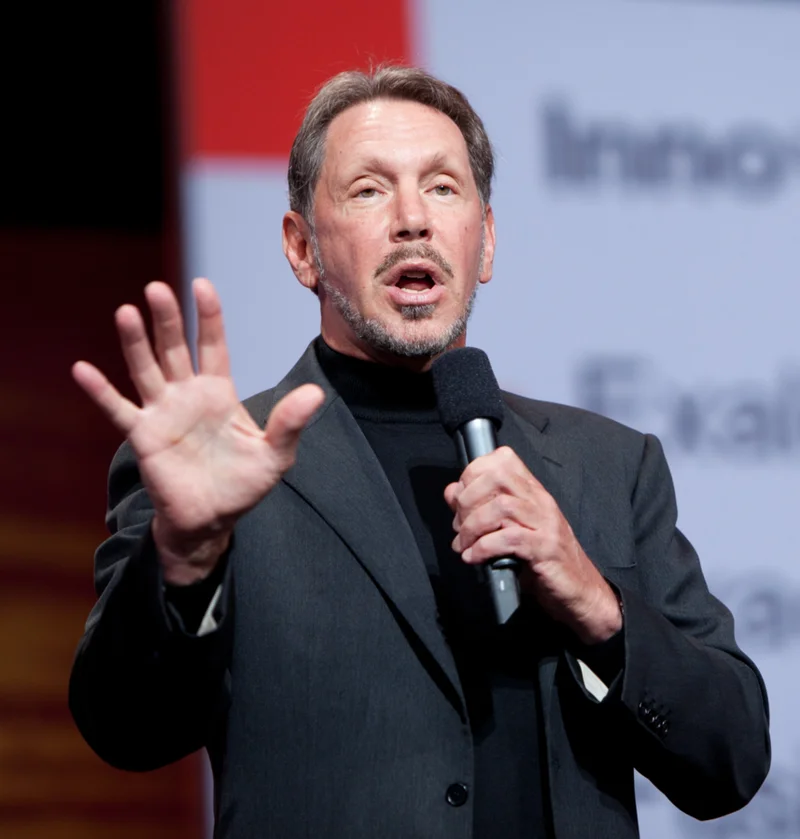
Of course, the immediate reaction is fear. It’s the vision Ellison himself once articulated of a society where AI and surveillance ensure citizens are "on their best behaviour." That sounds dystopian. But is that the necessary outcome, or is it a failure of imagination on our part?
We see other visionaries like Elon Musk building integrated systems for energy and transport, and we call it genius. We see a man whose net worth rivals that of Musk tackling the far more complex, far more human system of societal governance, and we call it a power grab. Why the disconnect? Perhaps because Ellison is working with the messiest material of all: us. Politics, media, and human identity itself.
To build something this ambitious, you can’t just sit in a lab. You have to engage with the world as it is. That means dealing with politicians like Donald Trump and Benjamin Netanyahu. It means funding think tanks to get your ideas into the halls of power. It means acquiring stakes in media platforms, from the old-world glamor of Paramount, where his son David Ellison is a major player, to the new-world algorithm of TikTok, because the flow of information is a critical part of the system. The speed of this integration is just staggering—it means the gap between our fragmented present and a unified future is closing faster than we can even comprehend.
This is the point where we, as technologists and citizens, have a profound responsibility. The specter of data privacy is very real. Building a system like this with centralized, top-down control would be a monumental error. But that’s not the only path forward. We can build this with cryptographic security, with zero-knowledge proofs, with individual data ownership baked in at the protocol level. We can create a system where you hold the key, and you grant access on a case-by-case basis. This isn't a "move fast and break things" scenario; it's a "measure twice, build a better world" paradigm shift.
Think of the invention of the standardized shipping container. Before it, global trade was a chaotic, inefficient mess of crates, barrels, and sacks of all sizes. The simple act of standardization unlocked the globalized world we live in today. What Ellison and his allies seem to be working on is the shipping container for identity. A standard that can unlock a new era of personalized services, efficient governance, and human-centric systems.
The UK's potential adoption of a digital ID, influenced by the TBI and its Oracle ties, isn’t just a British story. It’s a beta test. A proof-of-concept for a new model of society. And the potential prize is enormous—imagine what could be done with a unified, anonymized dataset like the one held by the NHS. Ellison has spoken of his desire to access this data, which experts value at £10 billion annually. The cynical take is that he wants to profit from it. The visionary take? He sees it as the key to training AIs that could cure diseases and revolutionize public health for the entire planet.
What could you build if the friction of modern life simply disappeared? What problems could we solve if our governments and institutions could operate with the speed and precision of a finely tuned piece of software? This isn't about control. It’s about coherence. It’s about upgrading the source code of society itself.
The Dawn of the Personal API
We’re standing at a precipice. Behind us lies the 20th century’s patchwork of analog systems, a world of friction, bureaucracy, and waste. Before us lies the potential for a truly integrated, intelligent, and responsive world. The path is fraught with political complexity and immense technical and ethical challenges. But to dismiss it all as a simple power grab by one of the world's richest men is to miss the breathtaking scale of the opportunity. This is about creating a universal API for the individual, allowing each of us to interface with the world’s systems seamlessly and securely. It’s the biggest systems-engineering project in human history, and it's happening right now, right in front of us.
Reference article source:
