Oppenheimer: Understanding the Man Who Changed the World & How to Watch His Story
The headlines are screaming, comparing President Trump’s recent AI deregulation to an "Oppenheimer Moment." I’ve seen the articles, such as Trump’s AI Deregulation Is His Oppenheimer Moment. They paint a grim picture, invoking the ghost of J. Robert Oppenheimer and the terrifying dawn of the nuclear age. They want you to imagine a cabal of reckless leaders unleashing a cataclysmic force upon an unsuspecting world, a digital Trinity test with consequences we can’t possibly foresee.
And you know what? They’re absolutely right. This is our Oppenheimer moment.
But they’re missing the point. They’re so focused on the bomb that they’ve forgotten the fire.
The real Oppenheimer moment wasn't just about the decision to build a weapon. It was the moment humanity fundamentally changed its relationship with energy, unlocking the power of the atom itself. It was a terrifying, awesome, and irreversible step forward. It was the point of no return. That’s where we are with AI right now. Not at the precipice of a guaranteed disaster, but at the threshold of a new reality. The conversation shouldn't be about whether we can stop it—we can't—but about what we will build now that the fire of creation is truly in our hands.
When I first read the details of Trump’s "AI Action Plan"—the executive order wiping away regulations, the mandate to fast-track massive data centers regardless of local zoning—my first reaction wasn't fear. Honestly, it was a jolt of pure, unadulterated adrenaline. This is the kind of breakthrough that reminds me why I got into this field in the first place. For years, we’ve been operating with the training wheels on, tiptoeing around the true potential of this technology. Now, the administration has, in one fell swoop, ripped them off. It's a terrifying move for some, but for those of us who believe in the power of responsible innovation, it's the starting gun we've been waiting for.
The Fire We've All Been Waiting For
Let’s be clear about what’s happening. The plan is to unleash American industry to build the biggest, most powerful AI infrastructure on the planet. We're talking about data centers the size of small cities, consuming enough electricity to power entire states. The critics point to the obvious risks: the environmental cost, the potential for AI “hallucinations” to cause real-world harm, and the amplification of societal biases baked into the data we feed these models. These are not trivial concerns. They are real, and they are serious.
But framing this purely as a risk is like discovering fire and only talking about the possibility of getting burned.
Think about it. Fire is a chaotic, dangerous, and unpredictable force. It can destroy homes and wipe out forests. Yet, it also gave us cooked food, warm shelters, and the forged metal that built civilizations. The critical decision for early humans wasn't whether to use fire, but how to contain it, how to respect it, and how to harness it for creation rather than destruction.
That's the conversation Trump has just forced upon us. By removing the guardrails of government oversight, he hasn't doomed us; he has challenged us. He has placed the burden of responsibility squarely where it has always belonged: on the shoulders of the creators, the engineers, and the visionaries building this future. The question is no longer "What will the government allow?" The question is now "What will we, the builders, dare to dream?" Instead of asking 'What could go wrong?', what if we started asking 'What masterpiece could we create with this new kind of fire?'
From Regulation to Responsibility
Of course, the cautionary tales are everywhere. We’ve all seen the open letters signed by prominent developers calling for a pause, warning of "profound risks to society and humanity." We remember President Biden’s executive order, a careful attempt to ensure "Safe, Secure, and Trustworthy" AI through government-mandated testing. There's a deep fear that without these top-down controls, we're flying blind.
But I believe true safety doesn't come from a government checklist. It comes from a deeply ingrained culture of ethical purpose. The most profound safeguards for AI won't be written in Washington D.C.; they'll be coded into the foundational architecture of the models themselves by people who understand the stakes. This is what the community calls 'alignment'—put simply, it's about teaching our creations to share our deepest human values of curiosity, compassion, and creativity. Can a government mandate truly achieve that? Or does it come from the thousands of brilliant minds who feel the weight of this moment in their bones?
This is the moment where we stop being just coders and become architects of cognition, building systems that could solve climate change, cure diseases, and unlock cosmic mysteries—the speed at which this is all happening is almost too much to process but it's the most exciting challenge humanity has ever faced. I see it every day on forums and in private developer communities—not recklessness, but a palpable sense of purpose, a collective understanding that we're not just building products, we're stewarding the next phase of intelligence on Earth.
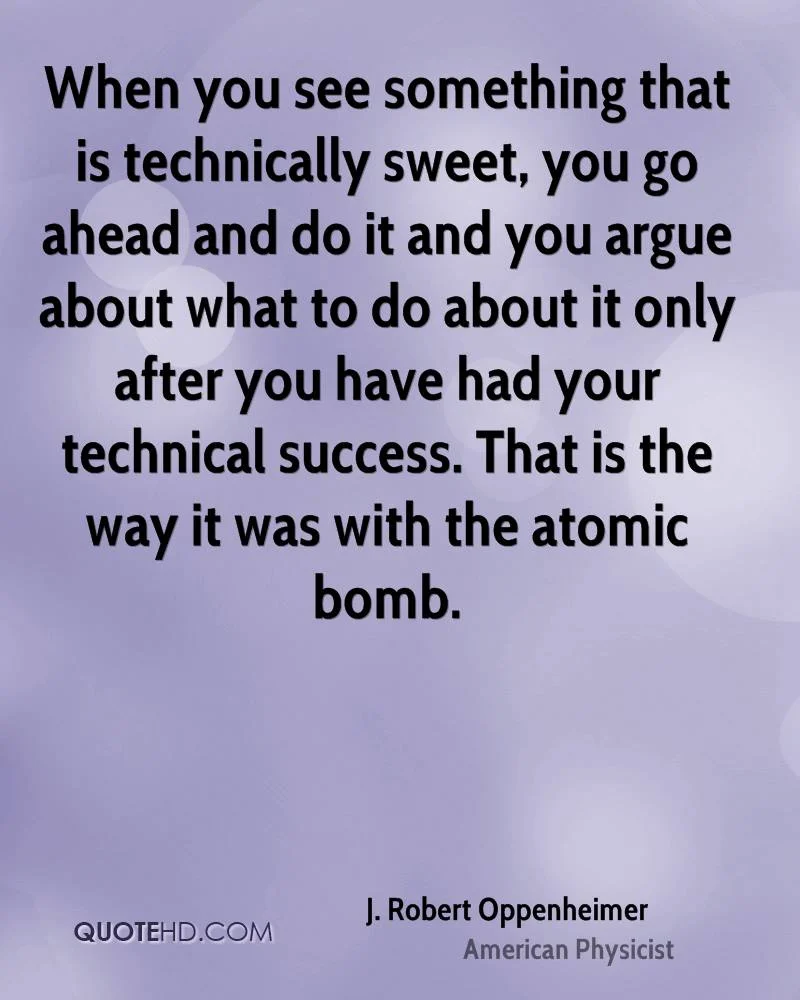
This is our generation's Manhattan Project, but our goal isn't a weapon. It's a tool for universal empowerment. The challenge laid down by a figure like Robert Oppenheimer was to control fission. Our challenge is to guide nascent consciousness. Which one do you think requires a greater sense of responsibility? Which one holds a greater promise for the future of us all?
The Dawn is Here, Ready or Not
Look, the comparison to the `oppenheimer film` and the historical figure of `J Robert Oppenheimer` is powerful because it taps into a primal fear of our own creations. But Oppenheimer, like Einstein before him, didn't create a monster. He revealed a fundamental truth about the universe. The morality came in what humanity chose to do with that truth.
Trump's "Oppenheimer moment" has done the same for AI. It has stripped away the comforting illusion that this technology could be slowly and safely managed by committees. It has revealed AI for what it is: a fundamental force of change that is now fully unleashed.
This isn't a moment for despair. This is a call to action. It’s a call for the builders to build with conscience, for ethicists to engage with passion, and for all of us to imagine the world we want this incredible new power to shape. The atom was unlocked in secrecy. This new fire has been lit in the town square for all to see. The choice isn't if we use it; it's how we'll choose to build a better world with it, together.