SpaceX Starlink Launch: What the 29th Booster Flight Actually Means
The Unseen Revolution in SpaceX's Boring Launches
Another week, another pair of lights in the sky. Early Tuesday morning, a Falcon 9 rocket painted a brief, silent tear in the fabric of the night sky over Cape Canaveral. A few hours earlier, on the opposite coast, a different Falcon 9 had done the same, arcing out over the Pacific from Vandenberg Space Force Base at 8:54 p.m. local time. Both were, by all accounts, perfectly nominal. One carried an unspecified payload; the other was a mission where SpaceX launches 28 Starlink satellites with a Falcon 9 booster flying for a 29th time – Spaceflight Now.
On the surface, these events are barely news. They have become the background noise of the modern space industry—a predictable, almost metronomic pulse of launches. And this is the part of the story that I find most compelling. The most disruptive innovation isn't the fire and noise of liftoff; it's the profound, almost unnerving silence and routine that now surrounds it. The story isn't that SpaceX is launching rockets. The story is that we’ve largely stopped paying attention.
We’ve been conditioned to view spaceflight as a grand, high-stakes drama, a national event punctuated by held breaths and cheering mission control rooms. But the data from Tuesday night’s Vandenberg launch tells a different story. It’s a story about logistics, depreciation, and operational tempo. It’s a story about a specific piece of hardware: a Falcon 9 first-stage booster with the tail number B1071. Tuesday was its 29th mission. Let that number sink in. Not its second, or its ninth. Its twenty-ninth.
The Monotony of Mastery
The Falcon 9 booster is starting to look less like a marvel of astronautical engineering and more like a piece of industrial equipment, akin to a long-haul cargo truck or a commercial airliner. Its flight manifest reads like a seasoned veteran’s resume: it’s lofted a NASA science satellite (SWOT), conducted five missions for the National Reconnaissance Office, and served as a cosmic bus for four separate rideshare missions. After pushing its payload towards orbit on Tuesday, it performed its autonomous landing on the droneship ‘Of Course I Still Love You’—a procedure now so refined it feels like an afterthought.
This is where the paradigm shifts. A rocket launch used to be a singular, high-risk event. Now, it’s just one leg of a given booster’s operational lifecycle. The launch itself is becoming a commoditized service, and the real asset is the reusable hardware. This isn't rocket science anymore; it's fleet management. It's the same cold calculus that a company like FedEx or Maersk uses to manage its planes and container ships. The goal is maximizing the number of duty cycles per asset to drive down the per-unit cost of service.
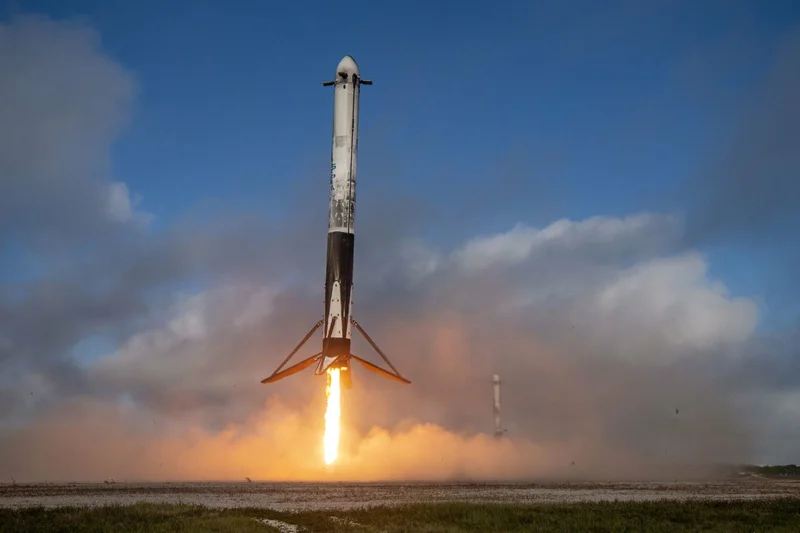
My analysis of this isn't about celebrating the engineering, but about examining the economic model it enables. Each successful flight and landing of B1071 is another data point validating this model. The 29th flight is significant not because it’s a record (the most-flown booster is still ahead of it), but because it signals a new phase of operational maturity. The question is no longer if a booster can be reused, but how many times before the economics of refurbishment no longer make sense. What is the actual, data-defined operational ceiling for a Falcon 9? Is it 35 flights? 50? At what point does the accumulated stress on the airframe create a risk profile that outweighs the cost savings? We don't have that data yet, because no one has ever operated a fleet like this before.
Deconstructing the Fleet's Ledger
Let’s zoom out from B1071 and look at the aggregate numbers. The landing on Tuesday was the 156th successful recovery on that specific droneship and the 516th booster landing overall. I’ve looked at hundreds of corporate filings and operational reports in my career, and it’s rare to see a company so thoroughly dominate the fundamental metrics of its industry. These aren’t just vanity statistics; they represent a dataset on reusable rocketry that is, for all practical purposes, proprietary and priceless. While competitors are still working to achieve their first successful booster recovery, SpaceX is accumulating a trove of performance and stress-test data that is likely orders of magnitude larger than the rest of the world's combined.
This data advantage creates a moat that is far more formidable than any single patent. It allows for iterative design improvements, refined refurbishment processes, and an actuarial understanding of risk that no one else can replicate. How can a competitor accurately price a launch contract when their entire model is based on theoreticals and simulations, while SpaceX’s is based on over 500 real-world data points? How does this relentless launch cadence—about 100 launches a year, maybe more—to be more exact, a pace of one launch every three to four days—impact the risk models for the entire commercial space insurance industry?
The two launches within hours of each other from opposite coasts are the perfect illustration of this operational dominance. It’s a demonstration of parallel processing capability that no other launch provider, state-sponsored or private, can currently match. It suggests that the bottleneck is no longer the rockets themselves, but ground infrastructure and payload readiness. The system has become so efficient that the constraint is no longer the performance of the primary asset, but the logistics supporting it. This is a problem every transportation CEO dreams of having.
The Real Metric Isn't Altitude; It's Amortization
Ultimately, the story of B1071's 29th flight is an economic one. What we are witnessing is the transformation of space access from a capital-intensive, high-risk venture into something that looks suspiciously like a scheduled utility. Each launch amortizes the massive R&D and manufacturing cost of the hardware over an ever-increasing number of flights, driving the marginal cost of reaching orbit down to a level that was, frankly, unthinkable a decade ago. The true disruption here isn't technological spectacle; it's the brutal, unyielding logic of a balance sheet. SpaceX isn't just winning the space race; it's fundamentally changing the financial rules of the game.