The US Navy's Railgun Debacle: What went wrong and why Japan is now showing theirs off
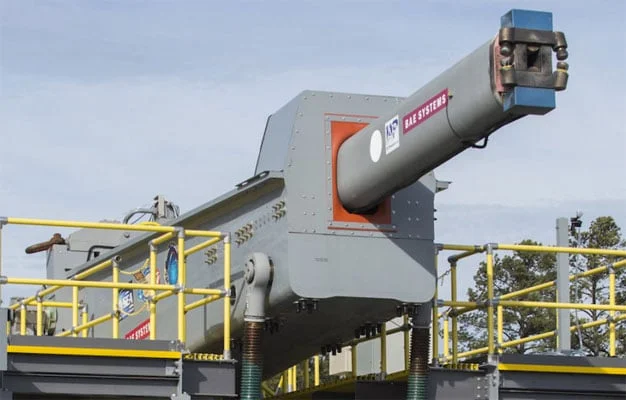
So, the U.S. Navy had a superweapon. A real-deal, sci-fi electromagnetic railgun that was supposed to change naval warfare forever. It was going to fire projectiles at Mach 7 using nothing but magnets and raw, unadulterated power. We spent years and god knows how many hundreds of millions of dollars on it. We saw the flashy test videos. We heard the breathless promises from admirals and defense contractors.
And then, it just… vanished.
Poof. Gone. The program was quietly shelved, and the official explanation was a masterclass in Pentagon-speak about “technical challenges” and “budgetary headwinds.” Give me a break. Let’s call it what it was: a colossal failure. Now, years later, Japan is bolting a working railgun onto one of its ships and actually hitting targets with it.
You can’t make this stuff up. The country that gave us the Walkman and the PlayStation just took America’s half-baked science project, fixed it, and put it on a boat. And I have to ask: what the hell happened?
The American Dream of a Gun That Melts Itself
Let’s be brutally honest about why the Navy’s railgun died. The core problem wasn’t the idea; the idea was awesome. The problem was reality, and the Pentagon’s allergy to it. The entire program was like trying to build a starship by strapping a thousand fireworks to a canoe. They obsessed over the flashy part—the insane muzzle velocity, the 32-megajoule energy blasts—but completely ignored that the canoe was, you know, made of wood.
The official report might as well have been two words: “cracked barrels.”
After firing fewer than 30 shots, the immense heat and electromagnetic stress would literally tear the gun apart from the inside. Thirty shots. No, that’s not a typo. You’d get more mileage out of a disposable camera. Imagine a firefight at sea where you have to call a timeout every two dozen rounds to replace the entire barrel of your billion-dollar cannon. It’s a joke.
Then there was the power issue. The weapon demanded an absolutely ludicrous amount of electricity, something only the boutique, hyper-expensive Zumwalt-class destroyers could even dream of providing. For every other ship in the fleet, you’d have to choose between firing the railgun or keeping the lights on. It was a weapon designed for a navy that doesn't exist. This wasn't a practical weapon system; it was a PR stunt looking for a home. A solution in search of a problem it was physically incapable of solving without self-destructing.
And offcourse, while all this was happening, I just found out some crypto bros named their digital privacy wallet "Railgun." I guess when your project is built on hype and promises you can't keep, you might as well steal the name of a failed Pentagon project. It's almost poetic, really.
Japan Reads the Instruction Manual
While the U.S. was busy making headlines, Japan was apparently doing the boring, unglamorous work of actual engineering. They looked at the core problem—the gun destroying itself—and decided to fix it. This is a bad idea. No, "bad" doesn't cover it—this is a fundamentally different philosophy. Instead of chasing bigger megajoule numbers for a press release, they focused on material science.
Their goal was a barrel that could survive 120 rounds. And according to them, they did it. They claim their blend of metals and materials can handle the abuse without significant damage. They’ve already conducted ship-board firing tests, first in 2023 and again this year, where a Japanese Warship Fires Railgun At Target Vessel For The First Time. While the US was drawing up PowerPoints, Japan was putting holes in things.
They’re now working on the rest of the system: continuous firing, a fire control system, shrinking the power source. You know, all the stuff you need to turn a lab experiment into a weapon. They're even collaborating with French and German researchers. They're treating it like a serious engineering challenge, not a sci-fi movie prop.
So what’s the real secret here? Did Japanese metallurgists invent some unobtanium alloy, or was the U.S. Navy’s approach just that fundamentally flawed from the start? Are we supposed to believe that an entire ecosystem of American defense contractors, labs, and naval researchers couldn't figure out what a team in Japan seemingly cracked? Or maybe, just maybe, our system is so obsessed with the next "game-changer" that it can't be bothered with the tedious details that make things actually work. We wanted the sizzle, and they just quietly cooked the steak.
The Pentagon, for its part, is trying to spin its failure into a win. They’ll tell you the real prize was the hypervelocity projectile (HVP), the super-fast, non-explosive slug the railgun was designed to fire. And sure, they’re now adapting that projectile to be fired from conventional 5-inch deck guns and Army howitzers. It’s a nice consolation prize, I guess. It’s like spending a decade and a billion dollars trying to build a Ferrari and ending up with a really nice set of tires. You can put them on your Honda Civic, and it'll probably handle a little better, but it ain't a Ferrari.
And honestly, you have to wonder if that was the plan all along...
So We Got a Faster Bullet. Cool.
Let’s get this straight. The United States poured a fortune into a revolutionary weapon, failed to solve the most basic engineering challenges, and then watched as an ally seemingly figured it out with a fraction of the fanfare. Our takeaway from this decade-long boondoggle is a new kind of ammo for our old guns. It’s the military-industrial complex in a nutshell: promise a revolution, deliver a marginal upgrade, and declare victory anyway. Meanwhile, the future is being built somewhere else, by people who were more concerned with making it work than with making a good headline. It’s not just embarrassing; it’s a warning sign.