LAX Flight Grounding: Analyzing the Equipment Outage and Systemic Impact
A Brittle System: The LAX and Dallas Shutdowns Were a Warning, Not a Fluke
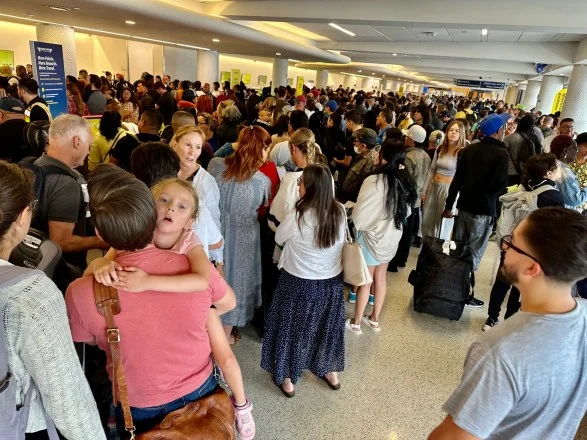
Over the weekend, a familiar scene of modern misery unfolded. Departure boards at Los Angeles International went dark. Crowds of travelers stood in stagnant lines, their faces illuminated by the glow of phones displaying canceled flight statuses. The official explanation was an "equipment outage"—a sterile phrase, echoed in headlines like LAX flights grounded due to equipment outage, FAA says, that does little to capture the cascading chaos that rippled out from one of the world's most critical aviation nodes.
Then, the problem replicated itself. In Texas, a telecommunications failure struck Dallas-Fort Worth and Love Field, knocking out radar and communications for air traffic controllers. Two of the nation's most vital airport systems, separated by over 1,200 miles, were effectively kneecapped by technical failures within the same news cycle.
The airlines did what they always do: they issued waivers and offered flexible rebooking. The FAA issued ground stops and then, eventually, lifted them. The news cycle moved on. But to treat this as just another bad travel day—a fluke of unlucky timing—is a profound misreading of the data. What we witnessed was not an anomaly. It was a scheduled stress test of the American aviation network, and the results were not encouraging.
The Anatomy of a Cascade Failure
Let's break down the sequence. First, LAX, an airport that handles roughly 1,500 flights daily, goes offline. The FAA’s ground stop is a blunt but necessary instrument, the equivalent of pulling the emergency brake on a train. But the national airspace isn't a single train on a single track. It’s an impossibly complex, interwoven mesh of routes, all dependent on a few key intersections. Shutting down LAX is like closing the 405 freeway at rush hour; the gridlock doesn't stay contained.
Hours later, the Dallas-area failure occurred. This one feels more acute. A telecommunications outage that affects both radar and voice communication is a controller’s worst nightmare. It removes their eyes and their voice. The resulting ground stop at DFW (a fortress hub for American Airlines) and Love Field (a Southwest stronghold) injected a second, massive shock into the system. Arriving flights at DFW saw delays climb to about an hour—or 68 minutes, to be exact.
The official statements from the FAA were, as is typical, opaque. "Equipment outage" tells us nothing. Was it a server failure? A software bug? A power supply issue? A fiber cut? The lack of specificity is, in itself, a data point. I've analyzed systemic risk in financial markets for years, and the pattern here is unnervingly familiar: a single point of failure triggers a cascade, and the post-mortem reports are carefully worded to prevent panic and liability.
This leads to the most important question that the official reports don't seem interested in answering: Was the near-simultaneous failure at two separate, major hubs a coincidence? Statistically, it's possible. But it seems improbable. Were these systems reliant on the same third-party software, the same network provider, or the same aging hardware components? Without a transparent, detailed technical breakdown, we're left to speculate about the very real possibility of a systemic vulnerability that affects more than just one airport.
The Illusion of Resilience
The response from carriers like American and Southwest was predictable and, from a customer-service perspective, adequate. Waiving change fees is the standard playbook. But this is a classic case of treating the symptom while ignoring the disease. A rebooking waiver is a financial remedy for a logistical crisis; it does nothing to address the infrastructural weakness that caused the problem in the first place.
The entire national airspace operates on a principle of maximum efficiency, not maximum resilience. The system is a finely tuned Swiss watch, engineered to move hundreds of thousands of people and tons of cargo with breathtaking precision. But like any such mechanism, its complexity is its weakness. When a single gear—a server in LA, a telecom link in Dallas—seizes up, the entire apparatus shudders. The ripple effects aren't a bug; they're a feature of a system designed with insufficient redundancy.
We saw reports of a cyberattack hitting European airports just a few weeks prior, crippling check-in systems run by Collins Aerospace. While the FAA was quick to state the LAX incident was not cyber-related, it highlights the expanding surface area of risk. Our aviation infrastructure is a patchwork of physical hardware and digital systems, and a failure in either can produce the exact same outcome: grounded planes and thousands of stranded passengers.
The core issue is that we treat these systems as infallible black boxes until they fail. Airports are undergoing multi-billion-dollar modernizations, with new terminals and automated people movers. But are we spending enough on the invisible infrastructure? The servers, the code, the fiber optic cables, and the backup power systems that are the true foundation of modern air travel? The weekend’s events suggest a significant discrepancy between the shiny passenger-facing upgrades and the robustness of the critical systems behind the curtain.
An Error in the System's Code
Let's be clear. The events at LAX and Dallas were not a fluke. They were a demonstration of the system's inherent brittleness. We have built an aviation network optimized for just-in-time perfection, where buffers and redundancies have been systematically stripped away in the name of efficiency. The result is a system that functions beautifully right up until the moment it catastrophically breaks. The airline waivers and apologetic announcements are a public relations anesthetic, designed to numb us to the reality that the foundational code of our air travel infrastructure is riddled with potential points of failure. This wasn't just a bad weekend for travelers; it was a glimpse of the new normal if we continue to ignore the rot in the machine.